Showing posts with label Philippine peso. Show all posts

Monday, February 25, 2013

Banknotes: 500 Pesos ADB Overprint

May 2-5, 2012, Manila, Philippines. The 45th Annual Meeting of the Board of Governors at ADB (Asian Development Bank). This banknote is the largest denomination in my collection so far. I hope I don't get tempted to take it and spend it when i am tight on the budget. So far its safely kept in my banknote album, away from me.


2012 500 Peso 45th Annual Meeting ADB Overprint
"Manila 2012"
"45th Annual Meeting of the"
"BOARD OF GOVERNORS"
"Asian Development Bank"
"Manila, Philippines 2-5 May 2012"
I don't recall exactly how I got this, but I think its from my change when I did my grocery last month. 10 million of these were printed so it shouldn't be that hard to find one in circulation.

Enjoy!

Thursday, February 7, 2013

Coin Collection: People Power Revolution Commemorative Coin


The people of the Philippines know very well the story of the People Power Revolution or EDSA revolution. The movement that ended the dictatorship of the former Philippine President Ferdinand Marcos in 1986. To commemorate this event, the Banko Sentral ng Pilipinas minted a one of a kind coin in 1988. Its a large, rather thick, coin made of pure nickel. I'm a proud owner of this coin. This was given to me back in college. Back then it was a beautiful coin, someone played around with it and dropped the thing. It has a rather ugly dent on its edge, but the coin remains uncirculated and its one of the coins i have that i am sure is UNC grade.

OBVERSE
Symbolisms of prayer, courage, and love
Lettering:
PEOPLE POWER REVOLUTION
PHILIPPINES FEBRUARY 22-25, 1986
See the dent on the lower left edge of the coin?


REVERSE
Seal of the Republic of the Philippines
Lettering:
REPUBLIKA NG PILIPINAS
10 Piso
According to the site http://en.numista.com, the rarity index for this coin is 74 on a scale of 0 to 100 where 0 is very common and 100 is very rare making this coin rather rare.

This coin commemorates the courage of the Filipino People who fought against tyranny and injustice. When liberty is threatened, the people are always ready to fight and defend that freedom. This revolution is one of a kind in that it was a non violent revolt against the Marcos regime.

Enjoy!

Monday, January 21, 2013

ASEAN Commemorative 50 peso bill


I found this 50 peso bill in our change when my friends and I had lunch at KFC yesterday. Its the old 50 peso design with the seal of ASEAN on it. A friend of mine commented that I am quick to notice these things and I just smiled in satisfaction for finding this bill.

This bill commemorates the Philippines being one of the founding members of ASEAN.

Close up of ASEAN logo.
(Association of Southeast Asian Nations)

I wont be spending this bill anymore and its been added to my collection. OK maybe I'll spend it when i am in a dire financial situation, but for now, its safely stored in my collection.

Enjoy!

Thursday, January 17, 2013

Coin Collection: Improved Flora and Fauna

I remember back in the 90's, there was a time when we started opening all our coin banks and started depositing our savings in the bank. During this time the coins in our "piggy banks" were the Philippine Flora and Fauna series coins. It made me curious why we started opening all our coin banks so I asked my parents why we were counting all our money and they just told me that the government is going to change our money. Initially, I thought that the government was really going around changing peoples money to new and shiny ones. Little did I know that the government was going to demonetize the current series.

It was 1991 when Banko Sentral ng Pilipinas started minting the new series. I don't recall the first time I saw the new coins, but I do remember commenting that the government shrunk our coins. The 5 peso coin was reintroduced in this series and I remember liking this coin because it was thick and heavy. It was also made of brass so the color intrigued me during the time. I even thought it was made of gold. I wasn't particularly fond of the new series of coins and it wasn't long until the government again changed the coins, back in 1995, to a new series which we still use to this day.

I have completed the Improved flora and fauna series thanks to my cousins donation. He gave me his 1991, 5 peso coin and 25 centavo coin. All my coins in this series are from the original minting year of 1991. These coins were minted until 1994. The 1, 5, and 10 centavos were retained from the original flora and fauna series so I didn't include them here.

25 SENTIMO
This was really small compared to the original. One can easily lose this coin.

25 SENTIMO REVERSE
It retained its original design it was just smaller.
This was donated by my cousin, Darryll Biscaro.

50 SENTIMO OBVERSE
The original was nickel. This one is made of brass. The size is almost the same as the 25 sentimo.
People sometimes accidentally interchange the two coins when giving out change.

50 SENTIMO REVERSE
The eagle is still there. Same design. No mint errors this time around.

1 PISO OBVERSE
Same design just smaller in size.

1 PISO REVERSE
The tamaraw is still there. One thing I observed when this came out was that it sticks to magnets.
Apparently, the metal was changed to stainless steel. I don't know if it was really stainless,
because I remember seeing rusted coins at home.

2 PISO OBVERSE
This one had a major change. Its no longer the decagon shaped coin we once knew.
It was changed to round and size was reduced, but the design remains the same.

2 PISO REVERSE
Yup! this is the coconut where you can tie the tamaraw from the 1 PISO to make 3 PISO.
If you didn't find that funny, you have no sense of humor.
Even though the size was reduced, the detail on the coconut is still amazing.

5 PISO OBVERSE
This was the new coin of the series. Of the coins in this series, this has to be my favorite.
It looked like a shiny gold coin to me back then. I even had the idea that it might be made
out of real gold. It turns out there is 0 gold in this coin.


5 PISO REVERSE
It took me a while to finally realize that the plant on this coin our national tree, the Nara.
Those are its leaves and seed pods on the coin.
Thanks to my cousin, Darryll, for donating this coin to my collection.

There you have it. The Improved Flora and Fauna series coins of the Philippines. Personally, the only improvement in this series is the 5 Peso coin. These coins are not rare. They can be easily acquired from coin shops at a very cheap price. In my set, none of the coins were purchased because they are still common that one can find these in old coin banks. Check your old coin banks, you may even have a complete 1991 series in pristine condition. As time goes by, of course these will eventually become rare. So if you have one that looks new, keep it. Or you can donate it to my collection. I would gladly accept it.

Enjoy!

Wednesday, January 16, 2013

DIY Coin Holder (2x2 Card Holder)


Supplies for coin collectors are not readily available where I come from. Most, if not all, supplies for the local coin collector here in the Philippines are imported from other countries and come with a premium. Its really a challenge to find a ready made coin holder made specifically for local coins. Most supplies i have seen online are for US coins that can be used for some of the local size coins.

A coin holder is a 2X2 piece of card with one edge closed and folded over. It has a plastic lining and serves to protect the coins from fingerprints and dirt. I was able to make my own coin holders from locally available materials from the local office supply store. Please note that i have not tested any of the materials for any compounds that might be harmful to coins, which means my holders do not conform with numismatic standards in coin storage and should not be used for high value coins.

Disclaimer: Please follow these instructions at your own risk. I will not be held responsible for any accident or injury you may sustain while doing this DIY project.

Lets get started. First of all, you need to prepare your materials.


  • MATERIALS AND TOOLS


1. A coin
2. Poster board
These come in large sheets. You will need to cut them to size.


3. Transparency
4. Scissors, stencil knife, pencil
5. Cutting board and flat clinch stapler

  • PROCEDURE


Step 1.
Cut the poster board and transparency to 2 x 4 inch size pieces.


Step 2a.
Fold the poster board crosswise with the white side out.
You will end up with a 2x2 square.
Step 2b.
Fold the transparency crosswise.
You will end up with a 2x2 square.

Step 3.
Take your coin and center it on the folded poster board and trace the coin.
Use an old coin of the same size to do this so that you wont have smudges on your subject coin.

Step 4.
Cut the traced circle using a stencil knife.
Be careful not to cut yourself.
Cut the board through and through.


Step 5.
Insert the folded transparency into the folded poster board.
Make sure closed ends are on the same side.
You now have a coin holder.
Take your coin and carefully center the coin in the holder then fold.

Step 6.
Align the coin such that the top should be at the folded side of the holder.


Step 7.
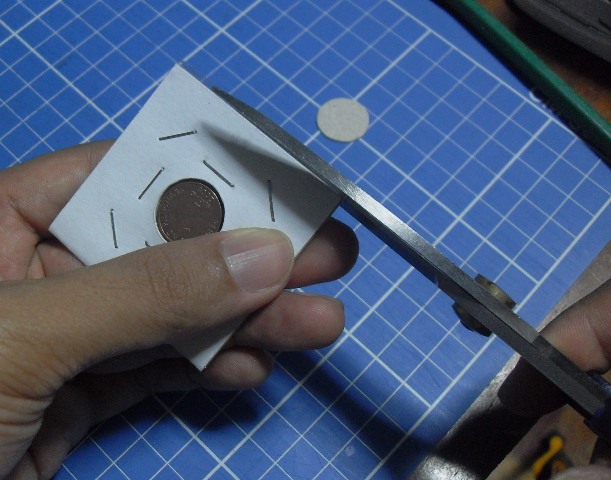
Take you flat clinch stapler and staple the 4 sides close to the coin.

You will end up with something like this.
The four staplers near the coin are usually enough.
I just like to add extra to flatten the holder.
You will notice some excess transparency protruding from the holder.

The back side. Notice how the staplers are flat instead of the normal arch?
Although normal staplers will do, it's best to get yourself a flat clinch stapler
so that you can have a flatter coin holder that is easy to insert in coin albums.

Step 8.
Take your scissors and cut the protruding transparency.

Step 9.
Take a pen and label you coin holder.

I usually label my coins this way.
Upper left is year of minting.
Top center is the series (Optional)
Lower left is the face value of  the coin.
Lower right is the country of origin.

Another example of how I label my coins. You may do so differently.
As far as i know, there is no standard for labeling.
Notice how the cut out is larger than the coin?
Sometimes I like to do it this way.
It allows me to see the edges of the coin and not just the faces.
Just use a larger coin to trace the circle.


I don't label the back side, unless there is something about the back that needs noting.


And you are done! Congratulations in making you own coin holder!

Please leave your comments and suggestions below. My procedure is in no way perfect and i am open to your suggestions.

Enjoy!

Friday, January 11, 2013

Coin Collection: Minting Error

1983 50 Centavo coin. Flora and fauna series (1983-1990) Philippines


The first minting of the Philippine 50 centavo coin of the flora and fauna in 1983 had a major error on it. As always Banko Sentral was quick to correct the error. I don't know how many error coins were actually put into circulation, but according to some websites, this error coin is quite rare nowadays, but the price is still relatively cheap.

Can you guess the error?


Bank Sentral made an error in the Philippine Eagle's scientific name. Can you guess which if the above is the mistake?
The left coin reads, "PITHECOPHAGA JEFFERYI." The one on the right reads, "PITHECOBHAGA JEFFERYI."

Did you notice the difference? The P and B. so which one is the error coin?

The one on the left is the correct one. The one on the right is the error coin. I didn't know about this error until recently and I am lucky enough to have lots of this error coins in hand thanks to a forgotten bag full of flora and fauna series coins at home. The error coin was still legal tender before and was accepted for trade.

I don't know the going rate for a good 50 centavo error coin, but i read in a forum once that some people are willing to trade fairly rare foreign coins for this. I have approximately 20 of these some are very ugly, but some are still in good condition. If anyone wants a coin like this, trade me something for it. hehe. O_O

This error coin in still quite good in appearance, but you can clearly see the scratches on the coin. The correct coin at the top is better looking, but then again the error was minted first, making it older the the correct coin.


A better closeup of the error.


Its kind of cool to have one of these and I am a proud owner of a piece of history that tell me even banks make mistakes. >_<

Below is the coin I separated. For me this is the most visually appealing of the bunch.


50 Centavo Coin Error - Philippines
"PITHECOBHAGA JEFFERYI."


50 Centavo Coin Error - Philippines
1983 50 Centavo coin. Flora and Fauna series.

Enjoy!

Thursday, January 10, 2013

Coin Collection: The Flora and Fauna Series

In 1983, the flora and fauna series of coins were first minted and introduced to the public. During my childhood, this was the coinage I grew up to know. The 1, 5, and 10 centavos were made from aluminum and was rarely accepted as currency in small stores so we played with those coins as play money. We called them "kulikak" and until now I have no idea where the term came from and what it really means. In case you know, maybe you can share. The 25 centavo coin, we called "binting", was the smallest acceptable denomination. The 50 centavo coin was nickel and featured the Philippine Eagle. We called this one "salapi". I'm not sure, but I think this coin is where the coin toss "tao o ibon" came from. Then there is the iconic "piso", 1 peso, with the tamaraw. Its funny because we all thought it was the carabao. I remember the first time I spent 1 peso because I called it "uno" instead of piso, which made the tindera laugh. Of course who can forget the unique, decagon shaped, 2 peso coin we call "dos". This was the highest coin denomination at the time; the five peso was still paper. The last year of minting for this series was in 1990. In 1991 they reduced the size of the coins, made the 2 peso coin round, but retained the 1, 5, and 10 centavos.

I recently collected the entire series. The 1, 5, and 10 centavo coins however are not from 1983. The rest from 25 centavos to the 2 peso coin are all 1983's. Again my goal is to complete a 1983 set. For now I'll make do with different dates.

Kulikak (1, 5, 10 centavo coins)
Obverse: Lapu lapu, "Republika ng Pilipinas", year mark
Reverse: Voluta imperialis, 1 Sentimo
Obverse: Melchora Aquino, "Republika ng Pilipinas", year mark

Reverse: Vanda sanderiana (Waling waling, a rare and highly-prized orchid endemic to the island of Mindanao)

Obverse: Francisco Baltasar, "Republika ng Pilipinas", year mark

Reverse: Pandaka pygmaea, 10 Sentimo

Binting (25 Centavos)

Obverse: Juan Luna, "Republika ng Pilipinas", year mark

Reverse: Graphium idaeoides, 25 Sentimo

Salapi (50 Centavos)

Obverse: Marcelo H. del Pilar, "Republika ng Pilipinas", year mark

Reverse: Pithecophaga jefferyi (Philippine Eagle/Monkey-eating Eagle), 50 Sentimo

Piso (1 peso)

Obverse: Jose Rizal, "Republika ng Pilipinas", year mark

Reverse: Anoa mindorensis (tamaraw), 1 Piso

Dos (2 pesos)

decagonal coin
Obverse: Andres Bonifacio, "Republika ng Pilipinas", year mark


decagon coin
Reverse: Cocos nucifera, 2 Piso

There you have it. My own Flora and Fauna coin collection. Info on the coins from:

I will share with you a cool trivia about the 50 centavo coin on my next post. This is all for now.

Enjoy!